
Move fast and don’t break the things we actually need (like climate and social stability)
The Actionist // 16 January 2026 // Written By Erin Gallup
AI’s outputs are often not worth the resources they use. Video: Erin Gallup / Hive Initiative.
The tech industry is spending nearly $400 billion this year alone on AI infrastructure- mostly on data centers that will consume as much electricity annually as 22% of all US households by 2028.
But there’s a question people are starting to ask: Are these investments worth it?
The environmental math doesn't add up
By 2030, US data centers will annually consume the water that could be used by 10 million people and will emit the CO2 equivalent to 10 million cars. The global AI demand will be estimated to use 4.2-6.6 billion cubic meters of water, which is equivalent to around 5 times the amount used by the country of Denmark. An average Google data center consumes 450,000 gallons (1.7 million liters) of water a day.
And a recent report found that CO2 emissions from the US AI industry’s explosive growth will be powered mainly by fracked gas and coal and take up 44% of the power sector’s budget for emissions, a sector already struggling to reduce.
Users aren’t that interested
Survey data shows only 8% of people are willing to pay for AI voluntarily. Nielsen Norman Group's UX research states that "AI features must solve real problems, not be implemented for novelty”, yet companies are cramming half-baked AI into everything from toothbrushes to mattresses, creating "solutions in search of a problem."
A recent analysis found that despite $30-40 billion in enterprise investment into generative AI, 95% of organisations are getting zero return.
Design failure
This isn't just poor product strategy. It's a fundamental design failure.
Traditional product design asks: "What problem or pain are users having, and does this solution actually help them?" The current AI integration asks: "How can we add AI to satisfy investors?"
The result? AI features that aren’t useful. AI slop that creates clutter and misinformation. Products that introduce more friction with new AI features.
Market instability
The IMF has compared current conditions to the dot-com bubble. AI-related capital expenditures now account for 1.1% of US GDP growth - meaning the broader US economy is literally propped up by data center construction.
Economic analysis from Harvard shows that without data centers, US GDP grew only 0.1% in H1 2025.
Societal cost
Utility companies are raising electricity rates by billions to finance AI infrastructure, passing costs to households and small businesses. Residential electricity costs in the US have jumped 30% since 2021.
Communities near large data centers have no say in their construction and face polluted air, water contamination, and health problems.
And companies are laying off their workers en masse and citing AI as the reason, without regard to the impact to the individual or society.
We must start implementing due diligence in our product design processes to account for AI's large environmental and social impact.
What actual due diligence would look like:
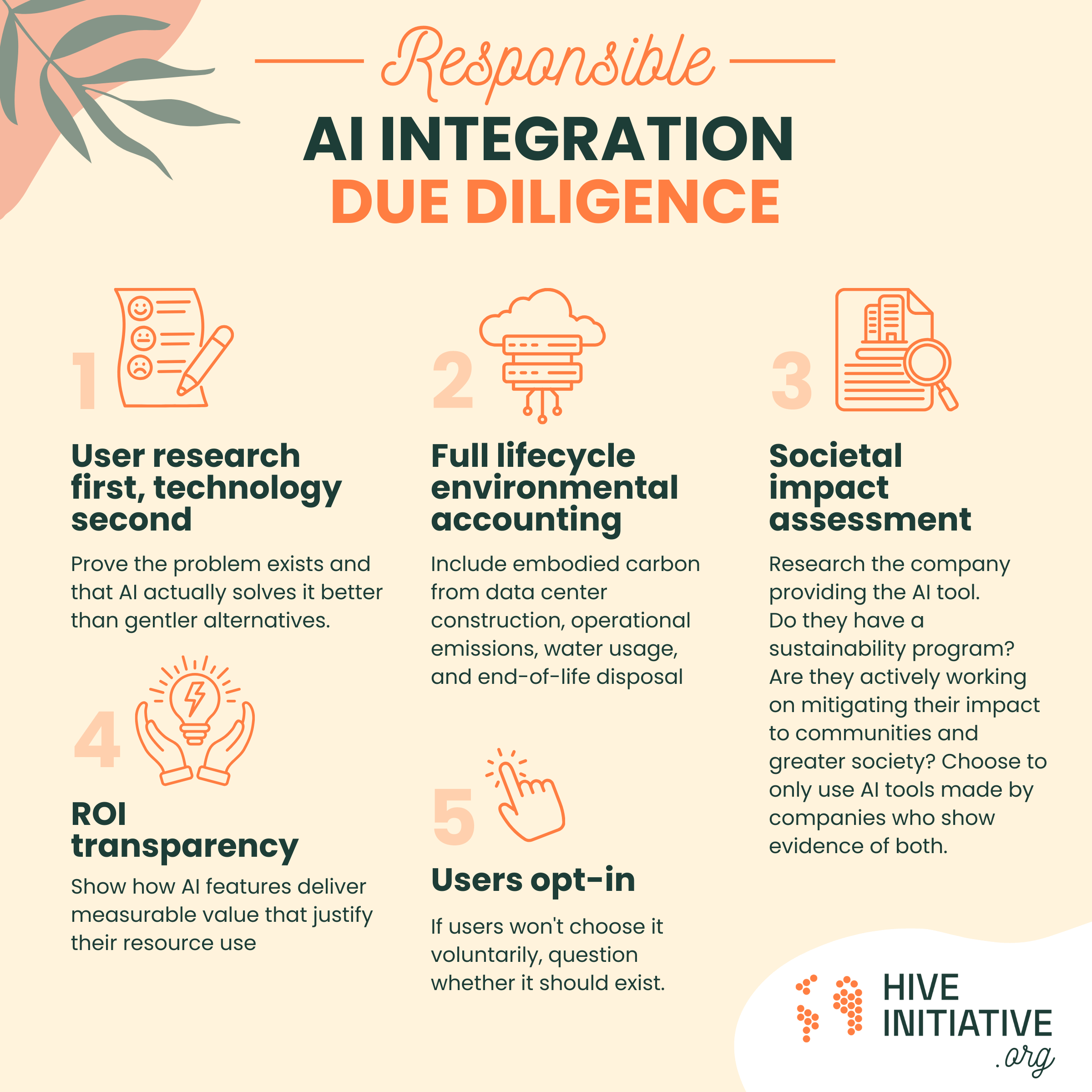
What responsible AI due diligence looks like. Graphic: Erin Gallup / Hive Initiative
The path forward
AI has genuine potential for specific applications, like speeding up software development, advanced weather prediction models, and medical diagnostics. But these targeted uses do not mean that AI should be everywhere.
We need product leaders willing to say "no" to AI features that don't pass basic user research. We need investors who value sustainable business models and planet and social stability over speculative hype. And we need governments who oversee AI, regulate it, and use its growth to strengthen social security systems.
The question isn't whether we can build it. It's whether we should, given its massive environmental and social cost - and whether anyone actually has a need for it.
. . .
Erin Gallup can be found on Linkedin.
. . .
Sources:
MIT Technology Review (2025), Xiao, T., Nerini, F.F., Matthews, H.D. et al. (2025),
Li,Pengfei L., et al. (2025), Google (2022), Fleming, J., Su, J. (2025), ZDNET/Aberdeen (2025), Nielsen Norman Group (2024), MIT NANDA (2025), Yale Insights (2025), Fortune (2025), Fortune (2025), Fortune (2025)